

From 75 Household Surveys to a Walk Into the Forest: Understanding Kampung Talukung, Kota Belud

Updated: 6 days ago
Our visit to Kampung Talukung, Kota Belud began with household data. It took us from conversations with villagers to water tanks, homes, farms, a damaged bridge and eventually into the forest — following the challenges back to where they begin.
A spreadsheet can tell us that a family is experiencing water shortages. It can show how far people travel to buy food, what they do for a living and whether they grow vegetables at home.
But numbers alone cannot show us what those challenges feel like in everyday life, why they are happening, or how one problem may be connected to another.
That is why our work in Kampung Talukung, Kota Belud, Sabah did not end when 75 households completed our community needs survey.
That was where it began.
The survey covered households across Zon Masjid, Zon Soborong and Zon Katol, representing at least 438 reported residents. The average surveyed household has approximately 5.8 people, and 76% reported having at least one child.
It gave us an early picture of a community where everyday life is closely connected to agriculture and village-based work.
More than half of respondents — 53% — identified farming or smallholding as their main occupation, while another 12% depend mainly on village or daily work. The survey also included homemakers and people currently without employment. Overall, at least 65% depend directly on agriculture or irregular village-based work.
Income is limited too. Nearly 79% of surveyed households reported gross household income below RM1,000 per month, while almost 95% reported below RM2,000.
Then, as we went deeper into the survey, one challenge kept appearing - Water. So we went to Kampung Talukung to understand the story behind the numbers.
01 — It Started With Sitting Down and Listening
Our first stop was not the water source. It was the community hall.
We sat together with the JKKK, tukang paip, leaders from the different zones and several households. Before measuring anything, we listened.
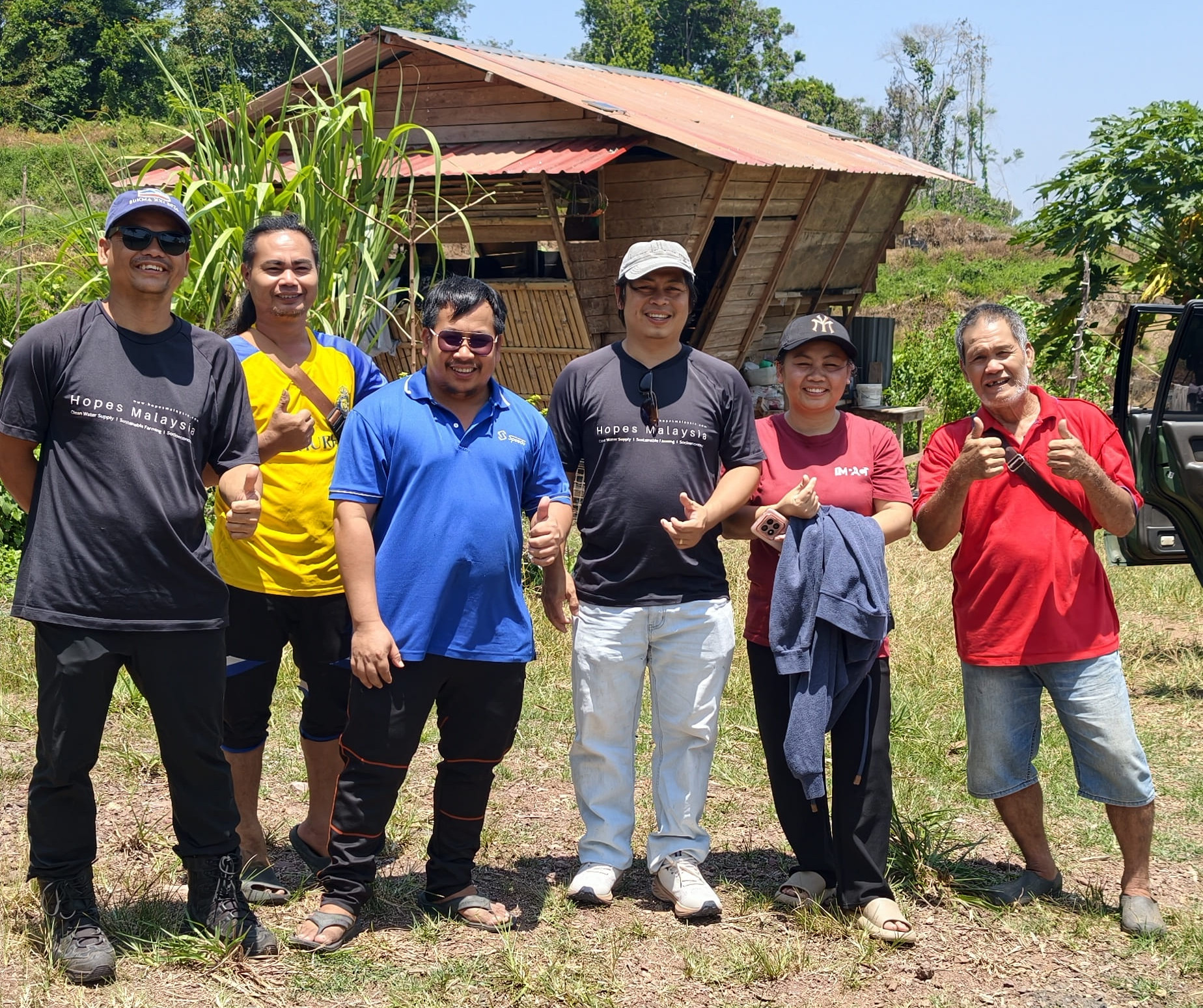
The people living with the water system every day helped us understand how it works, which areas usually receive weaker supply, where problems commonly occur and how conditions change when the dry season becomes prolonged.
For the community, this is not simply a potential “water programme”. It is the water they depend on every day. The survey had already shown us how serious the issue could be.
84% of surveyed households reported that their gravity-fed water reduces or becomes insufficient during prolonged drought. More than half experienced at least six shortages during the previous 12 months, while 23 households reported experiencing shortages more than 10 times.
And the problem did not appear to come from just one place. Residents reported reduced water at the source, trapped air in pipelines, blocked intakes, low pressure, blocked pipes, insufficient tank storage, leaks and unequal distribution between households.
The conversation helped us understand what people were experiencing. The next step was to follow the water ourselves.
02 — Following the Water Through Three Zones
From the community hall, we travelled through Zon Masjid, Zon Soborong and Zon Katol.
We checked distribution tanks and visited households at different points along the water network — including homes closer to the distribution points and those further along the line.

At each location, we observed the water condition and recorded GPS coordinates.
This matters because having water somewhere in a village does not necessarily mean every household receives the same supply.
A household close to a distribution tank may experience something very different from a family living towards the end of the pipeline.
The differences were already visible in the survey.
In Zon Katol, all seven surveyed households reported water shortages during prolonged drought, while six had resorted to collecting river water. In Zon Masjid, 31 of 38 surveyed households reported drought shortages and 34 had collected river water. Zon Soborong also faces significant drought shortages, although relatively more surveyed households reported having water reaching their planting areas during dry periods.

As we moved between homes and distribution points, percentages on a spreadsheet started becoming actual locations. So we continued upstream.
03 — From the Households to the Main Tank
Our next stop was the central water tank. Here, we checked the water level and observed the flow to better understand what was entering the distribution system.
A weak supply at a household does not automatically tell us where the problem begins. The source may be producing insufficient water. Storage may be inadequate. Pressure may be lost along the route. A pipeline may be blocked or damaged. Several issues may also be happening at the same time.
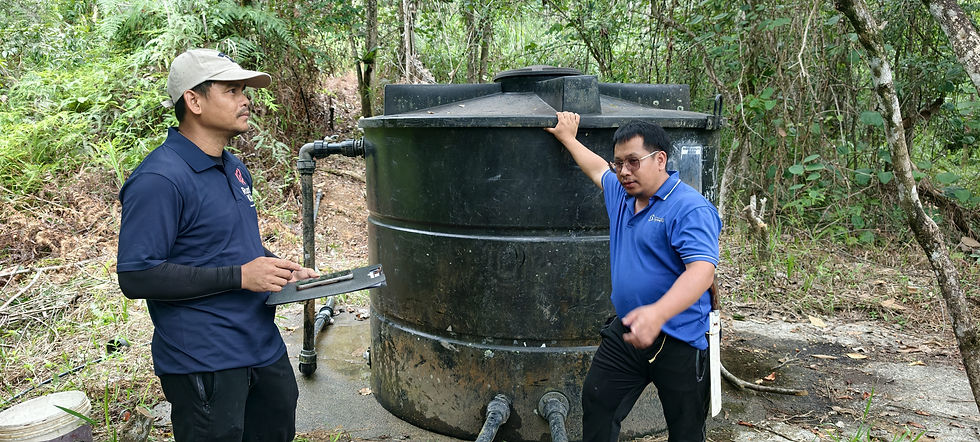
That is why we look at the whole system rather than one isolated point.
Based on the community survey, Kampung Talukung's water challenge appears to involve a combination of source limitations, storage, distribution and maintenance issues — all of which require technical verification before deciding what should be improved.
To understand the beginning of that system, we eventually had to leave the road behind.
04 — Then the Assessment Took Us Into the Forest
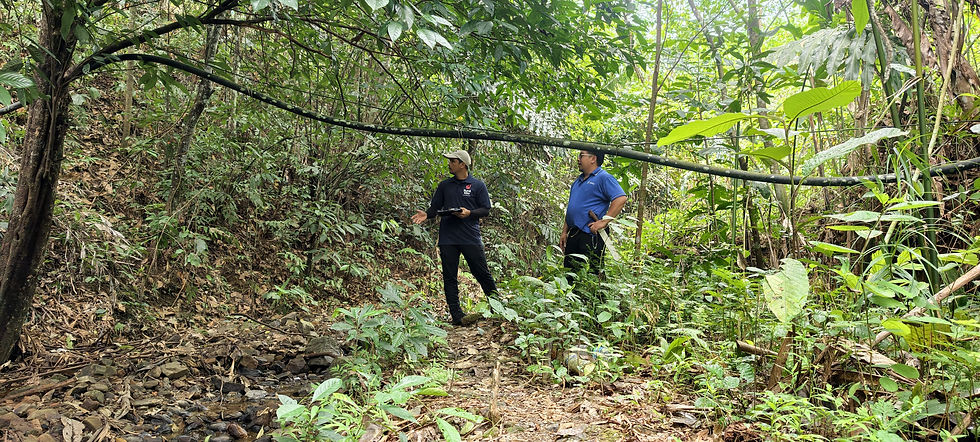
From the village, we followed sections of the gravity-fed pipeline towards its water source in the forest. The road ended. The walking began.
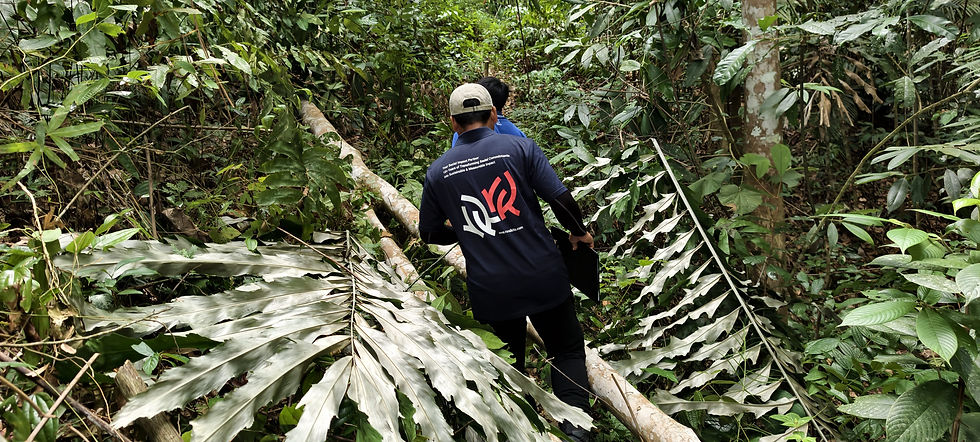
Our team followed the pipeline route, recorded GPS points, inspected visible sections and documented the physical conditions we encountered along the way. This is one of the less visible parts of rural community work.
A completed CSR programme may eventually be presented through simple numbers:
kilometres of HDPE pipeline installed, tanks improved, households reached, beneficiaries supported.
But before those numbers can responsibly appear in a proposal, someone first has to understand the route and the existing system.
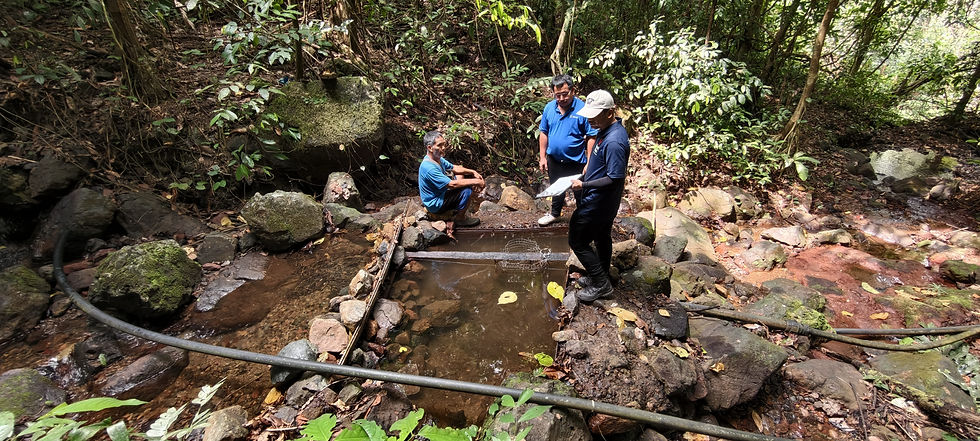
So we walked it. The household survey had already given us reasons to look closely. Fifty households reported reduced water at the source during dry periods. Others reported pipeline leaks or breaks, disconnected or damaged sections, blocked intakes and pressure
The consequences of those problems become much more human further downstream.
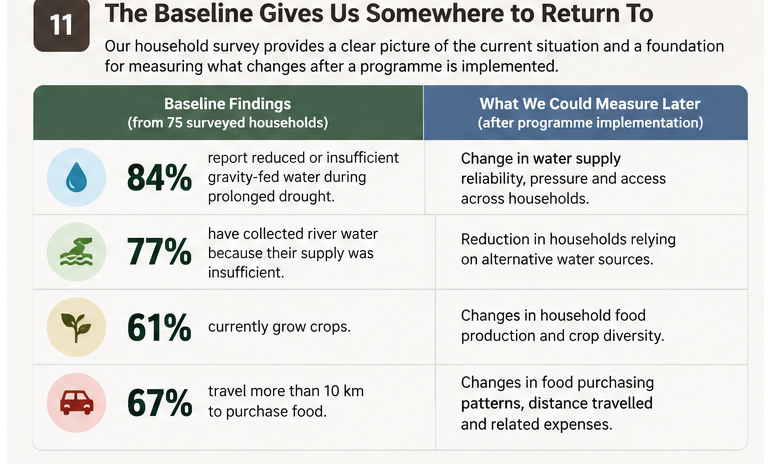
58 of 75 surveyed households — 77% — reported having collected river water because their gravity-fed supply was insufficient.
Eighteen households reported travelling at least 11 minutes one way to collect river water, while six reported journeys exceeding 30 minutes.
A damaged pipe somewhere in the forest can look like a small technical problem. Further downstream, it can mean a family having to find another source of water. And as we continued visiting households, we began to see that the water challenge did not end at the tap.
05 — Water Was Also Connected to What's Growing Beside the House
Household farming is already part of everyday life in Kampung Talukung.
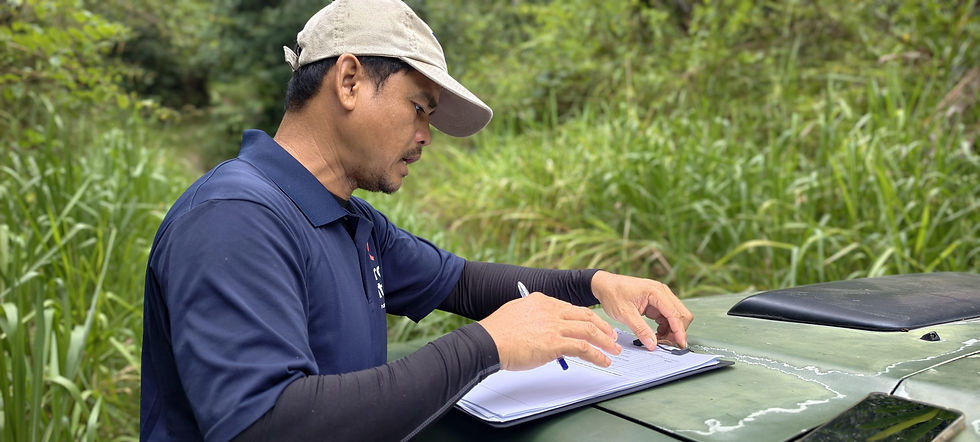
More than half of surveyed respondents identified themselves as farmers, and many households are already producing at least some food around their homes. During our visit, we spent time with households already growing crops and raising animals.
The survey supports what we saw: 61% of surveyed households currently grow crops, while 68% reported keeping livestock. Vegetables and fruit were among the most commonly reported crops, while chickens and fish were commonly reported livestock.
This is important. A future household food-production programme would not necessarily be introducing farming from zero.
There is already experience within the community. There is already interest. There are already vegetables growing beside people's homes.
But there are also practical limitations. And once again, water came first.
Thirty-five households identified water problems as a barrier to farming, making it the most frequently reported constraint, followed by a lack of tools and seeds or materials
From what we observed during the field visit, water availability can come and go. This means household farming cannot be viewed separately from the wider water situation. More reliable water could potentially create better conditions for families to produce more food for themselves.
And that becomes particularly meaningful when we look at what families currently go through to bring food home.
06 — For Many Families, Buying Food Also Means Travelling
For many of us, running out of vegetables means stopping at a nearby shop. For many households in Kampung Talukung, buying food involves a longer journey.
Two-thirds of surveyed households travel more than 10 km to purchase food.
At the same time, 76% spend more than RM50 each time they purchase vegetables, fruit and meat, including related transportation or fuel costs.
Almost 63% experience both conditions — travelling more than 10 km while spending more than RM50 per trip.
Their food purchases last a median of approximately 4 days. That allows us to look at the household burden from another perspective. If a family needs to replenish food roughly every four days, a 30-day month could involve approximately 7 to 8 shopping cycles.
At more than RM50 each time, that indicates more than RM375 per month in combined food and related transport expenditure for a household following that pattern.

It is an indicative calculation, not an exact monthly cost for every household. Shopping frequency and spending differ between families, and the survey combines food expenditure with transport rather than separating them. But it provides useful context.
Because nearly 79% of surveyed households reported gross household income below RM1,000 per month. For a household earning RM1,000, RM375 already represents at least 37.5% of monthly gross income.
Some families reported that what they purchase lasts only around three days. At that frequency, a household could make approximately 10 shopping cycles in a month. At more than RM50 each time, the combined food and related transport expenditure could exceed RM500.
For a household living on less than RM1,000 a month, that can become a significant burden.
And suddenly, the small vegetable gardens we had just visited looked different.
07 — A Small Garden Can Mean More Than a Small Garden
A few kilograms of vegetables may not look impressive in an impact report. For a household, their value can be much more practical. Vegetables harvested beside the house are vegetables that do not need to be bought somewhere else.
They may mean one less item on the shopping list. Over time, perhaps one less trip. Less fuel. And a little more household income available for another need.
That is why we do not necessarily see household farming as a programme designed to turn every participant into a commercial farmer.
For some families, producing food for their own table is already a meaningful outcome.
There is strong interest in doing more.

Almost 87% of surveyed households expressed clear interest in learning household food production, while 73% reported having at least a 20 ft × 20 ft space potentially suitable for planting.
But we also need to be realistic. Interest alone does not make a programme sustainable.
Water availability, suitable space, someone willing to care for the garden, participation in training and the willingness to continue using the household's own time and resources all matter.
The survey itself reinforces this distinction. While interest is high, only 29 households currently meet all four firm readiness indicators assessed.
For us, that is useful information. A meaningful programme is not necessarily the one with the biggest beneficiary number. It is one where people have a realistic opportunity to continue after the initial support ends.
08 — Then We Reached a Broken Bridge
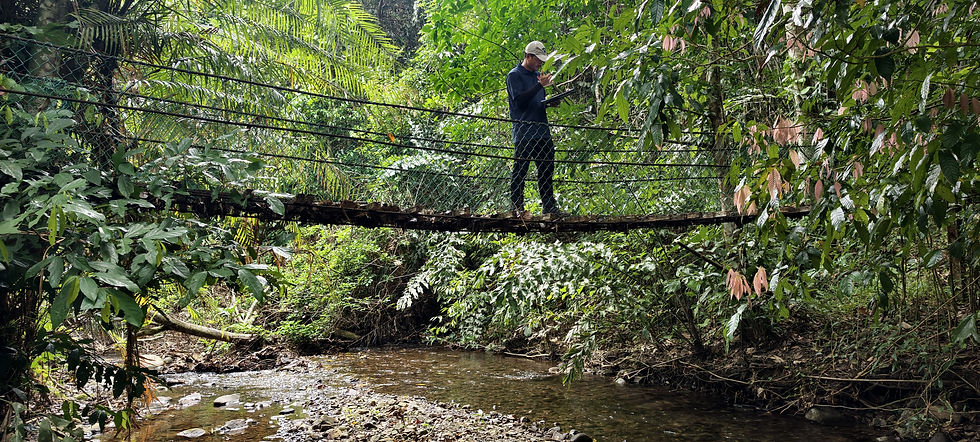
Our visit eventually brought us to another challenge — a community bridge with damaged and broken wooden planks. After spending much of the day following water and visiting household farms, it seemed like a completely different issue.
But standing there reminded us of something important. Communities do not experience their lives according to the categories we use in a proposal.
A CSR document may separate programmes into:
Water. Food security. Infrastructure. Livelihoods.
For a family living here, they are simply parts of everyday life.
A bridge provides access.
A farm depends on water.
Food grown at home can reduce what needs to be purchased elsewhere.
And household income affects how easily a family can absorb all those costs.
This is why community assessment needs to look beyond a single programme category. Communities are interconnected. Their challenges often are too.
09 — Somewhere Along the Way, the Spreadsheet Became a Village
We arrived with 75 household responses. By the end of the visit, those numbers had places, faces and everyday realities behind them.
The 84% experiencing drought-related water shortages connected to the water system we had been following.
The 77% who had collected river water connected to what families do when their normal supply becomes insufficient. Reports of damaged pipelines connected to the route through the forest.
The 67% travelling more than 10 km to buy food gave new meaning to vegetables growing beside people's homes.
The high proportion of farmers and smallholders helped us understand why reliable water could influence more than household consumption alone.
And the damaged bridge showed us another part of rural life that a household survey could never fully explain. This is why our assessments bring different pieces together.
Household surveys provide the baseline. Community conversations give those numbers context. Field visits allow us to understand physical conditions. GPS mapping records where challenges occur. Technical observations help determine what may be feasible. Photos and field evidence document what we find.
One source of information alone is rarely enough. Together, they help us move from simply identifying a problem to understanding what may realistically be done about it.
10 — For an Organisation, This Is Where Impact Begins
For an organisation, a CSR, ESG, sustainability or social impact programme may eventually become a budget, timeline, number of beneficiaries and list of deliverables.
But before reaching that stage, someone needs to connect the pieces.
In Kampung Talukung, our assessment is beginning to reveal a possible relationship:
Unreliable Water → Household Water Challenges → Limits Household Farming → Continued Dependence on Purchased Food → Distance Adds Cost → Low Household Income Increases the Burden
This means improving water reliability could potentially create benefits beyond having more water available at home.
It may also create better conditions for families who are already growing food — or want to begin doing so — to produce more for themselves.

A potential impact pathway begins to emerge:
More Reliable Water → Stronger Household Food Production → Potentially Fewer Food Purchases or Trips → Reduced Household Cost Pressure
At this stage, however, this remains something to assess and eventually measure — not something to promise.
The report itself identifies water improvement as the highest programme priority and household farming as a potentially linked programme, while noting that final beneficiaries and programme design require further technical verification and household engagement.
That distinction matters.
Responsible social impact is not about finding the fastest way to spend a budget.
It is about understanding where an organisation's resources can create practical value — and establishing how we will know later whether they actually did.
11 — The Baseline Gives Us Somewhere to Return To
The 75 household responses are not only useful for designing a programme.
They give us a picture of before.
Today, 84% of surveyed households report reduced or insufficient gravity-fed water during prolonged drought.
Today, 77% have resorted to collecting river water.
Today, 67% travel more than 10 km to buy food.
Today, 61% already grow crops.
And today, nearly 79% report gross household income below RM1,000 per month.
If a programme eventually moves forward, we have somewhere to return to.
Six months later.
Twelve months later.
And beyond.
Instead of reporting only how many kilometres of pipeline were installed, how many tanks were improved or how many households received farming materials, we can begin looking at what changed in people's everyday lives.
Whether water became more reliable.
Whether fewer families needed to collect river water.
Whether participating households were able to produce more food.
Whether household food-purchasing patterns changed.
And whether the improvements were still working after the programme had ended.
That is where impact reporting begins to move beyond:
What did we deliver?
towards something much more meaningful:
What became better because of it?
12 — Sometimes Social Impact Starts With Muddy Shoes
By the time we were ready to leave Kampung Talukung, the 75 household responses no longer felt like rows in a spreadsheet.
Behind “water shortage” was a family that may need to find another source when the tap runs dry.
Behind “more than 10 km to buy food” was a household making that journey repeatedly while living on a limited income.
Behind a small vegetable garden was food that might not need to be purchased elsewhere.
Behind a damaged pipe somewhere in the forest was water that might never reach a family further downstream.
And behind a few broken wooden planks was a bridge that people still depend on as part of everyday life.
None of these things may look extraordinary on their own.
But small difficulties, repeated day after day, can become a very real burden.
That is why we walked.
From the community hall to people's homes.
From the distribution tanks to the main tank.
From the village into the forest.
From water pipes to household gardens.
And finally, to a damaged bridge.
We were not walking around Kampung Talukung simply looking for something that could become a CSR programme.
We were trying to understand what could genuinely become better.
And perhaps that is where the meaning of social impact becomes much simpler.
If we return one day after a programme has been completed, perhaps fewer families will need to collect water from the river.
Perhaps during the next prolonged dry period, a parent will turn on the tap and water will still be there.
Perhaps a family will harvest enough vegetables that there is a little less to buy that week.
Perhaps the money saved can be used for something else the household needs.
Perhaps that damaged bridge will simply become a bridge people can cross without thinking about the broken planks beneath their feet.
None of these changes need to look dramatic.
Sometimes the most meaningful impact is when a problem that used to be part of someone's everyday life no longer has to be.
That is the kind of change we hope to create.
Not only something delivered.
Not only something photographed.
Not only a number placed in an impact report.
But something that quietly makes everyday life a little easier, a little safer or a little more secure — and continues to do so after we leave.
Create an Impact With Us
Kampung Talukung is one community.
Across Sabah and beyond, there are other communities with different challenges, strengths and possibilities.
And every organisation also comes with different CSR, ESG, sustainability, employee engagement and social impact goals.
At RuralKita, our role is to help bring those two sides together. We work from community assessment and data collection to programme planning, design, implementation, monitoring, impact measurement and reporting — helping organisations understand where their resources can create meaningful and practical change.
Because your organisation's next social impact story does not have to be about what you gave.
It can be about the family that no longer needs to walk for water.
The household that can grow a little more of its own food.
The bridge that becomes safer to cross. Or a community challenge that, over time, becomes one less thing people have to worry about.


Comments